WebSiam.io
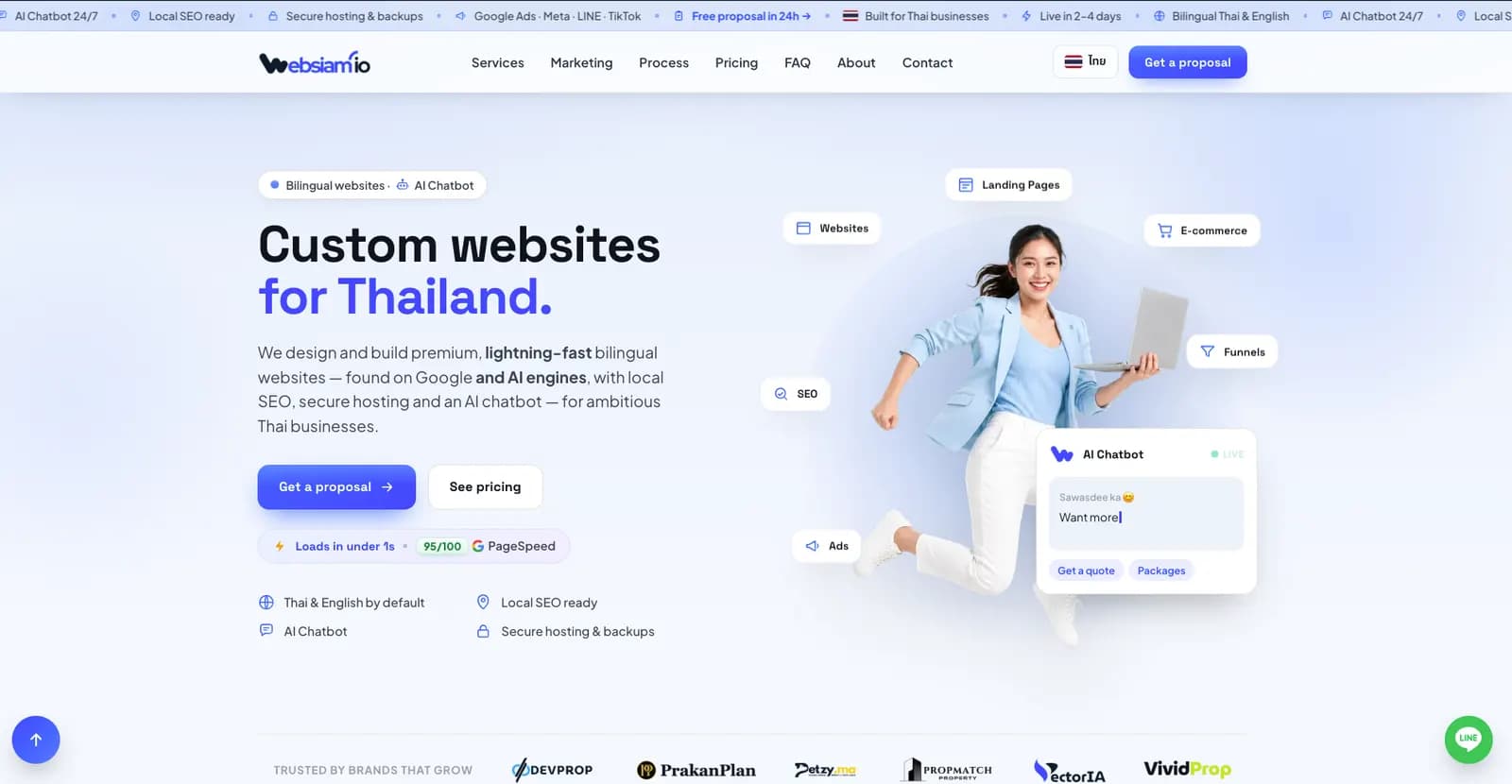
A Thailand-focused web and marketing agency building bilingual websites and the acquisition channels around them.
- My role
- Founder
- Relationship
- Founder
- Timeline
- Ongoing
- Live site
- websiam.io (opens in a new tab)
- Stack
- Not published. Technology choices are discussed directly where relevant.
01
Business context
WebSiam is a marketing agency for businesses operating in Thailand. Its offer combines a website with the channels that bring visitors to it, rather than treating the build as the whole project.
I founded it and currently run it alongside the other ventures.
02
The problem
Small and mid-sized businesses in Thailand often end up with a site built for one audience, no local search presence, and a separate vendor for traffic.
The result is a website that looks finished but does not produce conversations.
03
My responsibilities
- Founder: positioning, service design and hands-on delivery.
- Setting the build and marketing process the agency runs.
- Overseeing client delivery together with the other ventures I operate.
04
Constraints
- Clients are businesses, not technical teams: handover has to leave them able to operate the site.
- Two-language delivery (English and Thai) is required in most engagements.
- Marketing work has to stay honest about what traffic and ranking improvements can be promised.
05
The solution
- Custom websites built as a system of pages, templates and reusable blocks rather than one-off layouts.
- Bilingual English and Thai presentation as a default, not an add-on.
- SEO and local search foundations built into the site structure: metadata, internal linking, local business signals.
- Landing pages, e-commerce and funnel pages for campaigns that need to convert separately from the main site.
- An AI chat assistant on the site to qualify visitors before a human picks up the conversation.
- Hosting and backup setup included in delivery, so the client is not left with a site nobody maintains.
06
Architecture and important decisions
Build
- Custom websites
- Landing pages
- E-commerce & funnels
Reach
- SEO & local search
- Paid campaigns
- Content structure
Convert
- AI chat assistant
- Lead forms
- WhatsApp handoff
Functional map · internal architecture and implementation details are not published
Site and acquisition designed together
Page structure is planned around the search terms and campaigns the client will actually run, instead of adding SEO after launch.
Bilingual structure from the first wireframe
Language is part of the information architecture. Retroffitting a second language into a finished site always produces weaker copy and worse navigation.
Fixed, reusable page systems
Reusable blocks keep delivery fast and let the client add pages later without a redesign.
07
Trade-offs
- A block-based system delivers quickly and predictably, but limits highly bespoke visual concepts.
- Including hosting and backups creates ongoing responsibility for the agency, which is why it is scoped explicitly.
08
Screenshots
No product screenshot is published for this project yet. Rather than fabricate an interface, this case study stays text-led.
09
Verified outcomes and deliverables
- A public service offering with defined packages, process and pricing approach.
- Bilingual website delivery combined with SEO, campaigns and an on-site assistant.
- A repeatable delivery process that supports several concurrent clients.
No revenue, user counts, conversion rates or client metrics are published: none are verified for public use.
10
Lessons and next steps
- Clients judge a website by the conversations it produces, not by the launch.
- Bilingual delivery fails when copy is translated sentence by sentence; it has to be written for each audience.
Next
- Keep the offer narrow enough that quality does not depend on volume.
- Reuse more of the delivery system across ventures to shorten launch time.